






MEDDIC and Business Acumen: Why Qualification Criteria Are Only as Sharp as What's Behind Them
MEDDIC taught reps what to qualify for. Business acumen gives them a real basis for qualifying it.
What MEDDIC Actually Teaches
MEDDIC, developed at PTC in the 1990s by Jack Napoli and Dick Dunkel, is a qualification framework built for complex, multi-stakeholder B2B deals. The acronym lays out six criteria a rep needs before calling an opportunity real: Metrics (the measurable economic impact), Economic Buyer (the person who can actually authorize spend), Decision Criteria (what the buyer will evaluate against), Decision Process (how the decision actually gets made), Identify Pain (the compelling reason to act), and Champion (an internal advocate with real influence).
Where methodologies like SPIN or Sandler focus heavily on the conversation itself, MEDDIC is built for what surrounds it, the deal architecture. It forces reps to map the actual buying committee, find the person with real authority instead of the person who's simply been friendly, and quantify impact in terms the business will actually measure it by. That rigor is exactly why MEDDIC became the standard for enterprise and complex-deal sales organizations.
Done well, MEDDIC turns a fuzzy, relationship-driven pursuit into something closer to a structured investigation, six specific things to know, and real discipline about not moving forward until they're known.
Where the Model Runs Into Its Own Ceiling
MEDDIC is exceptional at telling reps what categories of information they need. It's far less prescriptive about how to actually get sharp answers within those categories, especially Metrics and Economic Buyer, the two criteria that require the deepest understanding of how the business actually works.
A rep can dutifully fill in every MEDDIC field and still get it wrong. "Metrics" might get logged as a vague productivity percentage the buyer offered up on the spot, rather than the number that actually moves the needle for that company's leadership. "Economic Buyer" might get identified as the most senior person in the room, when the actual budget authority sits with someone else entirely, someone whose priorities were never uncovered because nobody understood the business well enough to know where to look. MEDDIC gives reps the checklist. It doesn't give them the fluency to fill it in accurately.
Where Business Acumen Fills the Gap
This is where business acumen sharpens MEDDIC directly. A rep who understands what a company is strategically trying to accomplish, where cash and growth pressure actually sit, is far better equipped to identify the real Economic Buyer, the person whose numbers are actually under pressure, and to define Metrics in terms that person's own leadership is already tracking, rather than a generic productivity stat invented mid-call.
Take a concrete example. A MEDDIC-trained rep selling a security platform might log the Economic Buyer as the VP of IT, since that's who's been running the evaluation, and set Metrics around reduced incident response time. A business-acumen-fluent rep, who came in understanding this company recently went through a costly compliance audit and is under board-level pressure to reduce risk exposure ahead of a public offering, recognizes that the real Economic Buyer is more likely the CFO or General Counsel, and that the Metric that actually moves budget isn't response time, it's audit risk reduction, a number the board is already watching.
To be clear, this isn't about reps arriving with a org chart they built from public filings and telling the buyer who really holds the budget. It's about reps having enough strategic grounding, some real sense of the company's pressures, growth stage, and where scrutiny is likely landing internally, to ask sharper questions while filling in MEDDIC's own criteria, and to recognize when the answer they're getting doesn't match what the business's actual situation would suggest. That's real financial and strategic substance, the kind CPAs earn CPE credit for, made usable without an accounting background, and it's exactly what turns six checklist fields into an accurate read of the deal.
Turning This Into Practice
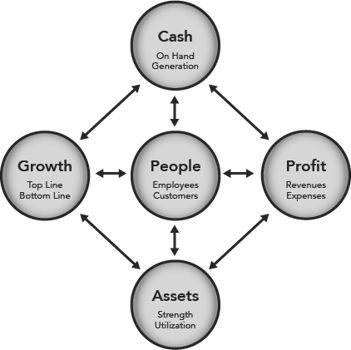
All of this sits on top of one underlying model: the 5 Business Drivers, cash, profit, assets, growth, and people. It's a principle-based way of understanding what any business is trying to accomplish and where its real challenges are. It's the same framework whether a rep is running MEDDIC, Challenger, Sandler, SPIN, or a homegrown sales methodology, because it gives reps a way to fill in a qualification framework accurately instead of confidently guessing at the answers.
So if you're running MEDDIC and want your team qualifying deals with real strategic fluency instead of best-guess answers, there are two ways to build that.
Acumen Intelligence™
For reps who need that homework done fast, Acumen Intelligence builds an account-specific briefing before the call, doing in minutes what would otherwise take hours of research, so the insight walking into the room is grounded in that company's actual situation.
Full Account Analysis
Enter a public company and get executive priorities, financial signals, and strategic focus areas—mapped to the 5 Business Drivers.
Read or Listen to the Call
Go straight to the source with thousands of earnings call transcripts and recordings—read the moment or hear it in the executive's own words.
AI Sales Co-Pilot
Chat with a co-pilot trained on our methodology to shape talking points, pressure-test your case, and walk into the next call ready.
Corporate Sales Training
Get your team trained. Acumen Learning's corporate training programs teach the 5 Business Drivers directly and give reps live practice applying them, building the fluency to do that homework well on any account, without starting from zero every time.
Tool-Agnostic Prompting
Reps learn prompts that work with Claude, ChatGPT, Copilot, Gemini, or whatever's in your tech stack—these skill travels with the rep.
Grounded in the 5 Business Drivers
Every search maps to Cash, Profit, Assets, Growth, and People—so the output speaks the language the C-suite actually measures.
From Research to Talk Track
Reps turn financial findings into an executive-ready business case and talking points—not just a pile of data they don't know how to use.
Filling In the Framework
(MEDDIC tells reps what to find out. Konrath explains what it takes to actually find it.)
Acumen Learning wrote the book that gives MEDDIC's checklist something real behind it, and Jill Konrath, bestselling author of Selling to Big Companies and SNAP Selling, agrees, calling it a framework that helps reps "quickly capture, and keep, a business leader's attention" and "accelerate decision-making." It's earned the same endorsements from top leaders sellers already trust: Matt Dixon, Jeb Blount, Anthony Iannarino, and Stephen M.R. Covey.
Want to quickly capture, and keep, a business leader's attention? If so, this book provides a clear and practical framework for engaging executives in a way that builds trust and accelerates decision-making. Well worth a read!
— Jill Konrath
Bestselling author of Selling to Big Companies and SNAP Selling
Choose the option that fits you best
Four ways to get the book
Buy on Amazon
Want your own copy right now? Get the print or Kindle edition.
Request a free copy
Available at no cost to leaders actively evaluating business acumen training for their teams.

Included with Acumen Intelligence
Already have, or considering, a subscription? Digital and audio editions are included free.
Get free reader resources
Already have the book? Grab worksheets, guides, and bonus tools.
Frequently Asked Questions About MEDDIC and Business Acumen
Do I need a finance background to use business acumen with MEDDIC?
No. Business acumen is a strategic fluency, not an accounting skill. Reps learn to understand what a company is likely trying to accomplish and where real budget pressure sits, enough to fill in MEDDIC's criteria accurately, without needing to analyze financial statements.
Does business acumen replace MEDDIC, or work alongside it?
Alongside it. MEDDIC provides the qualification categories: Metrics, Economic Buyer, Decision Criteria, Decision Process, Identify Pain, Champion. Business acumen provides the strategic grounding that makes those answers accurate, especially Metrics and Economic Buyer, the two criteria most dependent on understanding how the business actually works.
How much preparation does this actually take before a call?
More than none, less than a full financial analysis. Understanding a company's likely pressure points, growth stage, and where scrutiny is landing internally takes some real homework beforehand. Acumen Intelligence is built specifically to compress that homework from hours to minutes.
What's the fastest way to get my team doing this well?
Three starting points, depending on how deep you want to go: read Business Acumen for Sales Success to learn the 5 Business Drivers framework, enroll your team in Acumen Learning's corporate training for hands-on fluency, or use Acumen Intelligence to generate account-specific briefings before every call.
Is this only for reps who already use MEDDIC?
No. The 5 Business Drivers is the same underlying framework regardless of methodology, Challenger, Sandler, SPIN, or none at all. This page focuses on MEDDIC specifically because its structured qualification criteria make the connection especially direct, but the training and tools apply to any sales approach.