





Challenger and Business Acumen: Why the Best Teaching Pitch Still Needs a Business Case
The Challenger Sale changed how reps open conversations. Business acumen changes how they hold up once the conversation gets real.
What Challenger Actually Teaches
The Challenger Sale, built on research from Matthew Dixon and Brent Adamson, made a case that reshaped B2B selling: the highest-performing reps aren't the ones who build the best relationships. They're the ones who teach the customer something new about their own business, something the customer hadn't fully connected yet, and then use that insight to lead toward a solution only the rep's company can deliver.
That's the Challenger model in three moves. Teach for differentiation, tailor the message to the stakeholder in the room, and take control of the sales conversation instead of following the customer's lead. It works because most buyers don't actually want another rep confirming what they already believe. They want someone who shows up with a perspective they hadn't considered, backed by evidence, delivered with enough conviction to be worth their time.
Done well, this is genuinely disruptive selling. It's also why Challenger became one of the most influential sales methodologies of the last fifteen years, and why so many sales orgs, including plenty that call themselves Challenger shops today, still train reps on some version of "commercial teaching."
Where the Model Runs Into Its Own Ceiling
Challenger's power is also its exposure point. The entire model rests on the strength of the insight. If the teaching moment is generic, if it's really just a repackaged product pitch wearing a research citation, buyers spot it fast. Executive buyers in particular have sat through enough "insight-led" pitches to develop a sharp radar for the ones that are actually insightful versus the ones that are performing insight.
That puts enormous pressure on where the insight comes from. Most Challenger training focuses heavily on how to deliver a teaching pitch, the structure, the reframe, the emotional and rational impact sequencing, and comparatively little on how a rep builds an insight sharp enough to survive contact with a CFO. Reps are handed a script built from someone else's research and expected to sound like they arrived at it themselves. When a buyer pushes back with a specific question about their own numbers, that's usually where the performance cracks.
Where Business Acumen Fills the Gap
This is exactly the gap business acumen closes. Instead of a scripted insight the rep delivers the same way to every account, business acumen gives reps the strategic fluency to build the insight from that specific company's real situation, not a generic industry stat pulled off a slide.
Take a concrete example. A Challenger-trained rep selling supply chain software might open with a well-rehearsed insight about how "most companies underestimate the hidden cost of inventory carrying costs." It's a solid teaching pitch. But a business-acumen-fluent rep starts somewhere different, understanding what this specific company is actually trying to accomplish strategically, where their growth pressure is coming from, what tradeoffs they're navigating, and then connects the inventory conversation to that real strategic picture instead of a generic industry stat. One version is a slide. The other shows the buyer that the rep actually understands their business, not just their category.
To be clear, this isn't about reps going toe to toe with a CFO on financial statements, and it's not about needing an accounting background. But it does mean tracking some basic numbers well enough to stay grounded in the room, growth rate, margin trend, where cash is tight, so the strategic conversation is backed by something real instead of a guess. That's real financial and strategic substance, the same substance CPAs get CPE credit for learning, made usable without an accounting background. It's exactly what separates a Challenger pitch that sounds sharp from one that actually is.
Turning This Into Practice
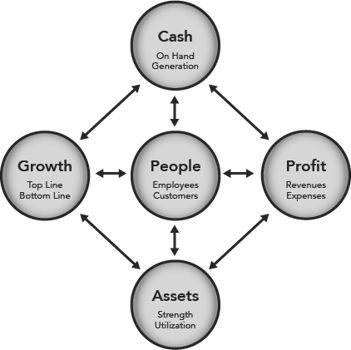
All of this sits on top of one underlying model: the 5 Business Drivers, cash, profit, assets, growth, and people. It's a principle-based way of understanding what any business is trying to accomplish and where its real challenges are. It's the same framework whether a rep is running Challenger, Sandler, MEDDIC, or a homegrown sales methodology, because it gives reps a way to orient their pitch to the company's actual strategy instead of a generic script.
So if you're running Challenger and want your team teaching from real strategic fluency instead of a script, there are two ways to build that.
Acumen Intelligence™
For reps who need that homework done fast, Acumen Intelligence builds an account-specific briefing before the call, doing in minutes what would otherwise take hours of research, so the insight walking into the room is grounded in that company's actual situation.
Full Account Analysis
Enter a public company and get executive priorities, financial signals, and strategic focus areas—mapped to the 5 Business Drivers.
Read or Listen to the Call
Go straight to the source with thousands of earnings call transcripts and recordings—read the moment or hear it in the executive's own words.
AI Sales Co-Pilot
Chat with a co-pilot trained on our methodology to shape talking points, pressure-test your case, and walk into the next call ready.
Corporate Sales Training
Get your team trained. Acumen Learning's corporate training programs teach the 5 Business Drivers directly and give reps live practice applying them, building the fluency to do that homework well on any account, without starting from zero every time.
Tool-Agnostic Prompting
Reps learn prompts that work with Claude, ChatGPT, Copilot, Gemini, or whatever's in your tech stack—these skill travels with the rep.
Grounded in the 5 Business Drivers
Every search maps to Cash, Profit, Assets, Growth, and People—so the output speaks the language the C-suite actually measures.
From Research to Talk Track
Reps turn financial findings into an executive-ready business case and talking points—not just a pile of data they don't know how to use.
The Challenger Co-Author's Own Verdict
(We didn't have to convince him.)
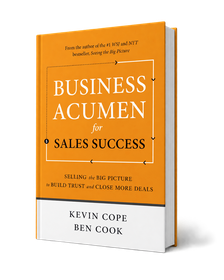
Acumen Learning wrote the book that fills Challenger's gap, and Matt Dixon, who co-authored The Challenger Sale itself, agrees. It's earned the same endorsements from top leaders sellers already trust: Jeb Blount, Anthony Iannarino, Jill Konrath, and Stephen M.R. Covey.
One of the most common criticisms revenue leaders have about their salespeople is that they lack the business acumen to effectively engage customers. Without a solid grasp of the dynamics of a customer’s business, sellers will always struggle to draw them into the sales process, keep the relationship at a senior level, and successfully navigate tough negotiations. If any of this sounds familiar, the very first thing you should do is have your team read this book cover to cover. It’s the best book on business acumen for sellers I’ve ever read.
Matt Dixon
Coauthor of The Challenger Sale, The JOLT Effect, and The Activator Advantage
Want a copy?

Frequently Asked Questions About Challenger Sales and Business Acumen
Do I need a finance background to use business acumen with Challenger?
No. Business acumen is a strategic fluency, not an accounting skill. Reps learn to understand what a company is trying to accomplish, where its pressure points are, and enough basic numbers, growth rate, margin trend, where cash is tight, to stay grounded in the conversation. It's not about going toe to toe with a CFO on financial statements.
Does business acumen replace Challenger, or work alongside it?
Alongside it. Challenger provides the structure: teach for differentiation, tailor the message, take control of the conversation. Business acumen provides the raw material that structure depends on, real understanding of the specific company's situation, so the insight a rep teaches is built for that buyer instead of borrowed from a generic industry script.
How much preparation does this actually take before a call?
More than none, less than a full financial analysis. Building a sharp, company-specific insight takes real homework, understanding the business's strategic position and a handful of relevant numbers, before a mission-critical call. Acumen Intelligence is built specifically to compress that homework from hours to minutes.
What's the fastest way to get my team doing this well?
Three starting points, depending on how deep you want to go: read Business Acumen for Sales Success to learn the 5 Business Drivers framework, enroll your team in Acumen Learning's corporate training for hands-on fluency, or use Acumen Intelligence to generate account-specific briefings before every call.
Is this only for reps who already use Challenger?
No. The 5 Business Drivers is the same underlying framework regardless of methodology, Sandler, MEDDIC, Solution Selling, or none at all. This page focuses on Challenger specifically because the teaching-insight model makes the connection especially direct, but the training and tools apply to any sales approach.