





Sandler and Business Acumen: Why Qualifying Hard Isn't the Same as Understanding Deep
The Sandler System changed how reps protect their time. Business acumen changes what they actually understand once a deal clears that bar.
What Sandler Actually Teaches
The Sandler Selling System, developed by David Sandler in the late 1960s, flipped the traditional sales dynamic on its head. Instead of the rep chasing the buyer, Sandler trains reps to act like a doctor before a prescription, diagnosing before proposing, qualifying hard before investing real effort into a deal.
The system runs through a structured sequence: building rapport without letting it become one-sided, establishing an upfront contract so both sides know what happens next, uncovering pain through deliberate questioning, and only then discussing budget and decision-making process. A Sandler-trained rep is taught to walk away from deals that don't qualify rather than chase them out of hope, protecting their time for opportunities that are actually real.
That discipline is exactly why Sandler has endured for decades. It trains reps out of the desperate, pitch-everything instinct and into something closer to a consultative filter, qualify hard, disqualify fast, and only spend real energy where there's a real fit.
Where the Model Runs Into Its Own Ceiling
Sandler's qualification framework is rigorous about process, pain, budget, decision, but it's largely agnostic about substance. The system teaches reps how to ask about pain; it doesn't teach them how to recognize which pain is actually significant to that specific business versus which pain is simply the first thing a stakeholder happened to mention.
That gap shows up constantly in practice. A rep can run a technically perfect Sandler qualification, upfront contract established, pain uncovered, budget confirmed, and still walk away with the wrong read, because the "pain" the buyer described was real but minor, while the pain that actually mattered to that company's leadership never came up. Sandler's questions are good at surfacing what a buyer says is wrong. They don't, on their own, tell a rep what's actually costing that business the most.
Where Business Acumen Fills the Gap
This is where business acumen sharpens Sandler rather than replacing it. Instead of relying entirely on what a buyer volunteers during pain-funnel questioning, a business-acumen-fluent rep walks into that same conversation already understanding what tends to matter most given that company's situation, where it's likely under pressure, what it's probably trying to accomplish strategically, so they can tell the difference between pain that's surface-level and pain that's actually driving the buying decision.
Take a concrete example. A Sandler-trained rep selling HR software might run a clean pain funnel and hear that the buyer is frustrated with manual onboarding paperwork. A generically-trained rep takes that at face value and prices a fix for onboarding. A business-acumen-fluent rep, who came in understanding this company is in a high-growth stretch and hiring aggressively, recognizes that onboarding friction isn't really the problem; it's a symptom of a company scaling faster than its systems can support, which is a much bigger, much more budget-worthy conversation than the buyer initially framed it as.
To be clear, this isn't about reps arriving with a spreadsheet and correcting the buyer's own account of their pain. It's about reps having enough strategic grounding, some sense of the company's growth trajectory, competitive pressure, where margin is likely tight, to ask sharper follow-up questions inside the Sandler framework itself, and to recognize when the pain being described is the tip of something bigger. That's real financial and strategic substance, the kind CPAs earn CPE credit for, made usable without an accounting background, and it's exactly what turns a technically correct qualification into a genuinely useful one.
Turning This Into Practice
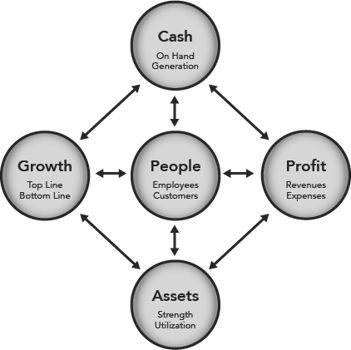
All of this sits on top of one underlying model: the 5 Business Drivers, cash, profit, assets, growth, and people. It's a principle-based way of understanding what any business is trying to accomplish and where its real challenges are. It's the same framework whether a rep is running Sandler, Challenger, MEDDIC, or a homegrown sales methodology, because it gives reps a way to recognize which pain is real before they've spent an entire qualification cycle finding out the hard way.
So if you're running Sandler and want your team qualifying with real strategic fluency instead of taking stated pain at face value, there are two ways to build that.
Acumen Intelligence™
For reps who need that homework done fast, Acumen Intelligence builds an account-specific briefing before the call, doing in minutes what would otherwise take hours of research, so the insight walking into the room is grounded in that company's actual situation.
Full Account Analysis
Enter a public company and get executive priorities, financial signals, and strategic focus areas—mapped to the 5 Business Drivers.
Read or Listen to the Call
Go straight to the source with thousands of earnings call transcripts and recordings—read the moment or hear it in the executive's own words.
AI Sales Co-Pilot
Chat with a co-pilot trained on our methodology to shape talking points, pressure-test your case, and walk into the next call ready.
Corporate Sales Training
Get your team trained. Acumen Learning's corporate training programs teach the 5 Business Drivers directly and give reps live practice applying them, building the fluency to do that homework well on any account, without starting from zero every time.
Tool-Agnostic Prompting
Reps learn prompts that work with Claude, ChatGPT, Copilot, Gemini, or whatever's in your tech stack—these skill travels with the rep.
Grounded in the 5 Business Drivers
Every search maps to Cash, Profit, Assets, Growth, and People—so the output speaks the language the C-suite actually measures.
From Research to Talk Track
Reps turn financial findings into an executive-ready business case and talking points—not just a pile of data they don't know how to use.
The Discipline Behind the Diagnosis
(Sandler taught reps to qualify hard. Iannarino explains what they're qualifying for.)
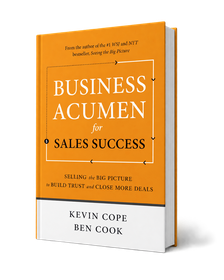
Acumen Learning wrote the book that gives Sandler's discipline something real to stand on, and Anthony Iannarino, author of The Only Sales Guide You'll Ever Need and The Lost Art of Closing, agrees, calling it a framework that helps sellers "move beyond product pitches and become the trusted advisor your clients actually need." It's earned the same endorsements from top leaders sellers already trust: Matt Dixon, Jeb Blount, Jill Konrath, and Stephen M.R. Covey.
Salespeople who create value win. The ability to tie your solution to real business drivers isn't optional, it's a discipline. Business Acumen for Sales Success gives you the framework to move beyond product pitches and become the trusted advisor your clients actually need.
— Anthony Iannarino
Author of The Only Sales Guide You'll Ever Need and The Lost Art of Closing
Choose the option that fits you best
Four ways to get the book
Buy on Amazon
Want your own copy right now? Get the print or Kindle edition.
Request a free copy
Available at no cost to leaders actively evaluating business acumen training for their teams.

Included with Acumen Intelligence
Already have, or considering, a subscription? Digital and audio editions are included free.
Get free reader resources
Already have the book? Grab worksheets, guides, and bonus tools.
Frequently Asked Questions About Sandler and Business Acumen
Do I need a finance background to use business acumen with Sandler?
No. Business acumen is a strategic fluency, not an accounting skill. Reps learn to understand what a company is trying to accomplish and where its real pressure points are, enough to recognize significant pain versus surface-level pain, without needing to analyze financial statements.
Does business acumen replace Sandler, or work alongside it?
Alongside it. Sandler provides the qualification structure: upfront contract, pain, budget, decision. Business acumen provides the strategic grounding that makes the pain-funnel questions sharper, helping reps recognize which stated pain is actually driving the buying decision versus which is a minor irritation.
How much preparation does this actually take before a call?
More than none, less than a full financial analysis. Understanding a company's likely pressure points and growth trajectory takes some real homework beforehand. Acumen Intelligence is built specifically to compress that homework from hours to minutes.
What's the fastest way to get my team doing this well?
Three starting points, depending on how deep you want to go: read Business Acumen for Sales Success to learn the 5 Business Drivers framework, enroll your team in Acumen Learning's corporate training for hands-on fluency, or use Acumen Intelligence to generate account-specific briefings before every call.
Is this only for reps who already use Sandler?
No. The 5 Business Drivers is the same underlying framework regardless of methodology, Challenger, MEDDIC, Solution Selling, or none at all. This page focuses on Sandler specifically because its pain-qualification model makes the connection especially direct, but the training and tools apply to any sales approach.