






Solution Selling and Business Acumen: Why a Good Diagnosis Needs a Real Patient History
Solution Selling taught reps to diagnose before prescribing. Business acumen determines how accurate that diagnosis actually is.
What Solution Selling Actually Teaches
Solution Selling, developed by Michael Bosworth in the 1980s and later refined through decades of enterprise sales practice, reframed the sales conversation around a simple but disruptive discipline for its era: don't propose a fix until you've properly diagnosed the problem. At a time when most sales training still centered on product features and closing techniques, Bosworth's model asked reps to behave more like a physician than a vendor, uncover symptoms, understand root cause, and only then discuss a remedy.
The methodology formalized this into a repeatable structure. Reps are trained to surface a buyer's pain through structured questioning, understand the business impact of that pain, help the buyer visualize a solution before one is proposed, and only then position an offering that maps directly to the diagnosis just completed. Selling tools like the "9 Box" vision-processing model gave reps a concrete way to walk a buyer from "I have a problem" to "I can picture the fix" without ever feeling pitched to.
That discipline mattered because it professionalized something reps had previously done inconsistently, if at all. A rep trained in Solution Selling doesn't open with a demo or a feature list. They open by trying to genuinely understand what's broken, and they treat getting that diagnosis right as the actual sale, with the eventual solution simply following from accurate diagnostic work.
Where the Model Runs Into Its Own Ceiling
Solution Selling is rigorous about the process of diagnosis. It's far less prescriptive about how a rep develops the judgment to diagnose accurately, and that gap matters more than it looks like on paper. A rep can follow every step of the Solution Selling process correctly, ask the right categories of questions, walk the buyer through pain and impact and vision, and still land on the wrong root cause, because what a buyer describes as "the problem" is frequently a symptom of something else, and telling the two apart requires real understanding of the business behind the symptom, not just good diagnostic technique.
This shows up constantly in practice. A buyer says response times are too slow. A technically correct Solution Selling process surfaces that pain, quantifies its impact in hours lost, and proposes a fix for response times. But if slow response times are actually downstream of a support org that's been under-resourced relative to a company scaling headcount faster than it can train new hires, fixing response times treats the symptom while leaving the actual driver, an unsustainable growth-to-support ratio, completely untouched. The rep did everything the methodology asked of them and still diagnosed the wrong condition.
Where Business Acumen Fills the Gap
This is where business acumen sharpens the diagnosis itself, not by replacing Solution Selling's process, but by giving the rep something real to diagnose against. A rep who understands what a company is likely navigating strategically, its growth stage, where competitive pressure is probably landing, whether margin is likely tight or comfortable, walks into a discovery conversation already holding a working hypothesis about what's actually driving the stated pain, rather than accepting the buyer's first framing at face value.
Take a concrete example. A Solution Selling rep selling customer support software hears a buyer describe long response times as the core problem and, following the methodology correctly, quantifies the cost of those delays and proposes a faster ticketing workflow. It's technically sound diagnostic work. A business-acumen-fluent rep, who came in understanding this company recently raised a large funding round and has been hiring aggressively across every department, including sales and customer-facing roles, recognizes something the surface conversation didn't surface on its own: the support org almost certainly hasn't scaled proportionally, and the real root cause isn't workflow inefficiency, it's a support function structurally behind the growth curve. That's a materially bigger conversation, a different buyer to loop in, and a solution that actually holds up over the next four quarters instead of six months.
To be clear, this isn't about a rep walking in with a diagnosis already decided and steering the discovery conversation to confirm it. Solution Selling's discovery process still does the real work of surfacing what the buyer is experiencing. What business acumen adds is the judgment to recognize when a stated symptom likely points somewhere larger, and to ask the follow-up questions that test that hypothesis rather than stopping at the first explanation offered. That's real financial and strategic substance, some sense of growth trajectory, margin pressure, where a company's likely stretched thin, the kind CPAs earn CPE credit for, made usable without an accounting background, and it's exactly what separates a diagnosis that's technically complete from one that's actually correct.
Turning This Into Practice
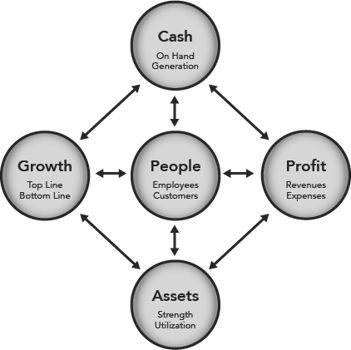
All of this sits on top of one underlying model: the 5 Business Drivers, cash, profit, assets, growth, and people. It's a principle-based way of understanding what any business is trying to accomplish and where its real challenges are. It's the same framework whether a rep is running Solution Selling, Challenger, Sandler, SPIN, MEDDIC, or a homegrown methodology, because it gives reps a way to trace a stated symptom back to its real cause instead of prescribing a fix for the wrong problem and finding out four quarters later that it didn't hold.
So if you're running Solution Selling and want your team diagnosing with real strategic fluency instead of taking the first explanation at face value, there are two ways to build that.
Acumen Intelligence™
For reps who need that homework done fast, Acumen Intelligence builds an account-specific briefing before the call, doing in minutes what would otherwise take hours of research, so the insight walking into the room is grounded in that company's actual situation.
Full Account Analysis
Enter a public company and get executive priorities, financial signals, and strategic focus areas—mapped to the 5 Business Drivers.
Read or Listen to the Call
Go straight to the source with thousands of earnings call transcripts and recordings—read the moment or hear it in the executive's own words.
AI Sales Co-Pilot
Chat with a co-pilot trained on our methodology to shape talking points, pressure-test your case, and walk into the next call ready.
Corporate Sales Training
Get your team trained. Acumen Learning's corporate training programs teach the 5 Business Drivers directly and give reps live practice applying them, building the fluency to do that homework well on any account, without starting from zero every time.
Tool-Agnostic Prompting
Reps learn prompts that work with Claude, ChatGPT, Copilot, Gemini, or whatever's in your tech stack—these skill travels with the rep.
Grounded in the 5 Business Drivers
Every search maps to Cash, Profit, Assets, Growth, and People—so the output speaks the language the C-suite actually measures.
From Research to Talk Track
Reps turn financial findings into an executive-ready business case and talking points—not just a pile of data they don't know how to use.
A Diagnosis Worth Trusting
(Solution Selling asks reps to diagnose. Blount explains what it takes to diagnose right.)
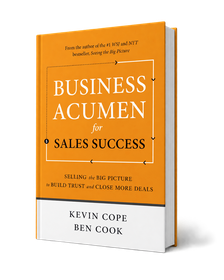
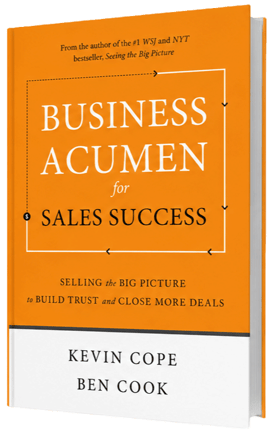
Acumen Learning wrote the book that gives Solution Selling's diagnosis something real to work from, and Jeb Blount, CEO of Sales Gravy and author of Sales EQ, agrees, calling it a book that helps reps "tie your message to the business outcomes executives actually care about." It's earned the same endorsements from top leaders sellers already trust: Matt Dixon, Anthony Iannarino, Jill Konrath, and Stephen M.R. Covey.
Top producers don't wing it, they prepare. Business Acumen for Sales Success shows you how to tie your message to the business outcomes executives actually care about. If you want to build more pipeline and close more deals, this book gives you the edge.
— Jeb Blount
CEO of Sales Gravy and author of Sales EQ
Want a copy?

Frequently Asked Questions About Solution Selling and Business Acumen
Do I need a finance background to use business acumen with Solution Selling?
No. Business acumen is a strategic fluency, not an accounting skill. Reps learn to recognize when a stated problem likely points to something larger, using an understanding of growth stage and business pressure rather than financial statement analysis.
Does business acumen replace Solution Selling, or work alongside it?
Alongside it. Solution Selling provides the diagnostic process, surface the pain, quantify the impact, build the vision. Business acumen provides the judgment that makes the diagnosis accurate, recognizing when a stated symptom is actually downstream of a bigger, more strategic problem.
How much preparation does this actually take before a call?
More than none, less than a full financial analysis. Understanding a company's growth trajectory and likely pressure points takes some real homework beforehand. Acumen Intelligence is built specifically to compress that homework from hours to minutes.
What's the fastest way to get my team doing this well?
Three starting points, depending on how deep you want to go: read Business Acumen for Sales Success to learn the 5 Business Drivers framework, enroll your team in Acumen Learning's corporate training for hands-on fluency, or use Acumen Intelligence to generate account-specific briefings before every call.
Is this only for reps who already use Solution Selling?
No. The 5 Business Drivers is the same underlying framework regardless of methodology, Challenger, Sandler, SPIN, MEDDIC, or none at all. This page focuses on Solution Selling specifically because its diagnostic model makes the connection especially direct, but the training and tools apply to any sales approach.