





SPIN Selling and Business Acumen: Why Implication Questions Need Something Real Behind Them
The Sandler System changed how reps protect their time. Business acumen changes what they actually understand once a deal clears that bar.
What SPIN Actually Teaches
SPIN Selling, developed by Neil Rackham after a landmark study of over 35,000 sales calls, identified a four-stage questioning sequence that separates high-performing reps from average ones: Situation questions to establish context, Problem questions to surface dissatisfaction, Implication questions to connect that problem to real consequences, and Need-Payoff questions to get the buyer articulating the value of solving it themselves.
The insight behind SPIN was that the highest-performing reps weren't the best talkers, they asked fewer Situation questions and dramatically more Implication and Need-Payoff questions than average performers. Instead of pitching a solution, they let the buyer arrive at the urgency and value on their own, guided there through a deliberate sequence of questions.
That's what makes SPIN durable decades after Rackham's original research: it's not a script, it's a questioning discipline, and disciplined questioning tends to outlast whatever product or market it was originally built around.
Where the Model Runs Into Its Own Ceiling
SPIN's entire engine runs on the Implication question, connecting a stated problem to a consequence the buyer hadn't fully connected. But the quality of that connection depends entirely on what the rep actually understands about the business behind the problem. A generic Implication question, "how does that affect your team's productivity?", is technically SPIN-compliant and largely forgettable. A sharp one connects the stated problem to a consequence that specific business's leadership actually tracks.
Most SPIN training teaches the questioning sequence itself extremely well, when to move from Problem to Implication, how to avoid stacking too many Implication questions and sounding interrogative, but it doesn't teach reps how to know, in the moment, which implications are the ones that will actually land. Reps are left improvising the substance of the best question in the sequence, using whatever context they happened to pick up earlier in the call.
Where Business Acumen Fills the Gap
This is where business acumen sharpens SPIN specifically. A rep who understands what a given company is likely trying to accomplish strategically, where its growth pressure sits, what it's probably navigating, can walk into a Problem-stage answer already holding two or three implication paths that would actually matter to that business, rather than improvising a generic one on the spot.
Take a concrete example. A SPIN-trained rep selling data infrastructure software might hear a Problem-stage answer about slow reporting cycles and ask a standard Implication question: "how does that slow reporting affect your team?" A business-acumen-fluent rep, who came in understanding this company just closed a new funding round and is under real pressure to show growth metrics to its board, asks a sharper version: connecting the slow reporting cycle directly to the company's ability to make fast, confident decisions in front of investors who are watching growth closely. Same question type, same sequence position, entirely different weight.
To be clear, this isn't about reps arriving with a stack of financial statements and steering the buyer toward a pre-decided implication. It's about reps having enough strategic grounding, some real sense of the company's situation, growth stage, competitive pressure, where things are likely tight, to recognize which implication is actually true for that business, and to ask it with real conviction instead of guessing. That's real financial and strategic substance, the kind CPAs earn CPE credit for, made usable without an accounting background, and it's exactly what turns a technically correct Implication question into one that actually changes the conversation.
Turning This Into Practice
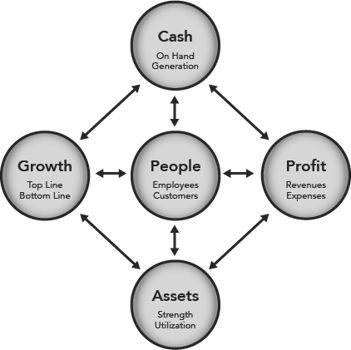
All of this sits on top of one underlying model: the 5 Business Drivers, cash, profit, assets, growth, and people. It's a principle-based way of understanding what any business is trying to accomplish and where its real challenges are. It's the same framework whether a rep is running SPIN, Challenger, Sandler, or a homegrown sales methodology, because it gives reps a way to know which consequences actually matter before they've asked the question and found out the hard way.
So if you're running SPIN and want your team asking Implication questions grounded in real strategic fluency instead of improvising them, there are two ways to build that.
Acumen Intelligence™
For reps who need that homework done fast, Acumen Intelligence builds an account-specific briefing before the call, doing in minutes what would otherwise take hours of research, so the insight walking into the room is grounded in that company's actual situation.
Full Account Analysis
Enter a public company and get executive priorities, financial signals, and strategic focus areas—mapped to the 5 Business Drivers.
Read or Listen to the Call
Go straight to the source with thousands of earnings call transcripts and recordings—read the moment or hear it in the executive's own words.
AI Sales Co-Pilot
Chat with a co-pilot trained on our methodology to shape talking points, pressure-test your case, and walk into the next call ready.
Corporate Sales Training
Get your team trained. Acumen Learning's corporate training programs teach the 5 Business Drivers directly and give reps live practice applying them, building the fluency to do that homework well on any account, without starting from zero every time.
Tool-Agnostic Prompting
Reps learn prompts that work with Claude, ChatGPT, Copilot, Gemini, or whatever's in your tech stack—these skill travels with the rep.
Grounded in the 5 Business Drivers
Every search maps to Cash, Profit, Assets, Growth, and People—so the output speaks the language the C-suite actually measures.
From Research to Talk Track
Reps turn financial findings into an executive-ready business case and talking points—not just a pile of data they don't know how to use.
What Trust Actually Requires
(SPIN gets the buyer to the implication. Covey explains why that's what earns trust.)
Acumen Learning wrote the book that gives SPIN's sharpest questions something real to stand on, and Stephen M.R. Covey, bestselling author of The Speed of Trust and Trust & Inspire, agrees, calling it a book that arms sellers "with the clarity, discipline, and insight to speak in the language executives respect." It's earned the same endorsements from top leaders sellers already trust: Matt Dixon, Jeb Blount, Anthony Iannarino, and Jill Konrath.
Trust is built when salespeople align what they offer with the real business challenges of their clients. In a world flooded with superficial pitches, Business Acumen for Sales Success fills a glaring gap by arming sellers with the clarity, discipline, and insight to speak in the language executives respect. This is more than a sales book, it's a bridge to credibility, value, and enduring trust.
— Stephen M.R. Covey
Bestselling author of The Speed of Trust and Trust & Inspire
Want a copy?

Frequently Asked Questions About SPIN and Business Acumen
Do I need a finance background to use business acumen with SPIN?
No. Business acumen is a strategic fluency, not an accounting skill. Reps learn to understand what a company is likely trying to accomplish and where its real pressure points are, enough to ask sharper Implication questions, without needing to analyze financial statements.
Does business acumen replace SPIN, or work alongside it?
Alongside it. SPIN provides the questioning sequence: Situation, Problem, Implication, Need-Payoff. Business acumen provides the strategic grounding that makes the Implication questions sharper, so reps are connecting a stated problem to a consequence that actually matters to that business.
How much preparation does this actually take before a call?
More than none, less than a full financial analysis. Understanding a company's likely pressure points and growth trajectory takes some real homework beforehand. Acumen Intelligence is built specifically to compress that homework from hours to minutes.
What's the fastest way to get my team doing this well?
Three starting points, depending on how deep you want to go: read Business Acumen for Sales Success to learn the 5 Business Drivers framework, enroll your team in Acumen Learning's corporate training for hands-on fluency, or use Acumen Intelligence to generate account-specific briefings before every call.
Is this only for reps who already use SPIN?
No. The 5 Business Drivers is the same underlying framework regardless of methodology, Challenger, Sandler, MEDDIC, or none at all. This page focuses on SPIN specifically because its Implication-question model makes the connection especially direct, but the training and tools apply to any sales approach.