





Business Acumen Works With Any Sales Methodology
Sales methodologies teach you how to run a conversation. Business acumen teaches you what to say once you're in it. Whether your team runs Challenger, Sandler, a homegrown process built over years, or just moves opportunities through Salesforce or HubSpot stages without a named framework, business acumen makes it stronger.
Every named sales methodology solves a different piece of the same underlying problem: how does a rep move from a first conversation to a signed deal without either chasing dead opportunities or losing the buyer's trust along the way. Challenger solves it by teaching reps to lead with a disruptive insight. Sandler solves it by refusing to invest real effort until a deal has actually earned it. SPIN solves it through a disciplined questioning sequence that lets the buyer arrive at their own urgency. MEDDIC solves it by forcing rigor into deal qualification before a rep calls an opportunity real. Solution Selling solves it by treating diagnosis as a formal, repeatable step instead of something reps do on instinct. Consultative Selling and Integrity Selling solve it through posture, positioning the rep as a trusted advisor whose recommendations are grounded in the buyer's actual needs and values rather than a script.
Each of those is a genuinely different mechanism, built by a different person, at a different point in the last several decades, for a reason specific to the sales problem it was designed to fix. But every one of them shares the same structural dependency: the methodology tells a rep how to move through a conversation, what sequence to follow, what to ask, what to qualify for, when to teach and when to listen. None of them tell a rep what's actually true about the business sitting across the table. That's a different kind of knowledge entirely, and it's the piece none of the seven methodologies above were built to provide.
Business acumen is that piece. It's not an eighth methodology competing with the other seven, it's the layer underneath all of them, real fluency in how a business generates cash, protects margin, funds growth, and manages its people, applied inside whatever structure a rep is already running. A Challenger rep uses it to build a teaching insight from the buyer's actual numbers instead of a rehearsed industry stat. A Sandler rep uses it to tell real pain apart from surface-level pain during qualification. A MEDDIC rep uses it to correctly identify the Economic Buyer instead of guessing based on who's been friendliest in meetings. Same underlying fluency, seven different applications, because the fluency isn't methodology-specific, it's business-specific.
That also means it isn't limited to the seven methodologies above. Most sales organizations don't actually run a single textbook methodology start to finish, they run some version of one, blended with years of internal practice, shaped around how deals move through Salesforce or HubSpot, refined by whoever built the process before the current team inherited it. That's a homegrown methodology, and it deserves the same grounding as any of the seven named above, which is exactly what the section below addresses.
What If We Don't Use a Named Methodology?
A homegrown process isn't a lesser version of a real methodology, it's usually a methodology in every sense that matters, just one that never had a name attached to it or a book written about it. It has qualification steps, even if nobody calls them MEDDIC criteria. It has a version of diagnosis before pitch, even if nobody calls it Solution Selling. It has stages a deal has to clear, tracked in whatever CRM the company standardized on, even if nobody ever formalized why those particular stages exist in that particular order. The absence of a name doesn't mean the absence of structure, and treating a homegrown process as something to apologize for, or worse, as a gap to fill with a named framework purchased off the shelf, misses that most homegrown processes work reasonably well precisely because they were built by people who actually understood the deals they were losing and adjusted accordingly.
What a homegrown process usually lacks isn't structure, it's the same thing a named methodology lacks on its own: a reliable way for reps to understand the actual business on the other side of every deal, independent of whatever stage-and-qualification structure moves that deal forward. That gap is identical whether a company calls its process Challenger or calls it "the way we've always sold," which is exactly why business acumen closes it the same way in both cases.
Does business acumen support a Salesforce-based sales process?
Yes, and it does real work at every stage rather than just at the top of the funnel. If your team is moving opportunities through Salesforce, qualifying leads, advancing them through defined pipeline stages, forecasting close probability, business acumen changes what goes into each of those steps. A rep who understands what's actually driving an account, growth pressure, margin position, competitive threat, qualifies more accurately at the top of the pipeline, writes closing notes that reflect real deal risk instead of optimism, and forecasts with a level of confidence that's actually earned rather than assumed. None of that requires a different tool. It requires the person filling in Salesforce to understand the account well enough that what they're filling in is accurate.
Does business acumen support a HubSpot-based sales process?
Yes, in the same way, applied to HubSpot's structure specifically. Whether your team runs deals through a HubSpot pipeline, logs deal stages, or manages the sales side of a broader HubSpot CRM setup, a deal only moves from one stage to the next accurately if the rep moving it actually understands whether that movement reflects genuine progress. A rep with real business acumen can tell the difference between a deal that's advanced because the buyer's actual need has been confirmed and a deal that's advanced because a rep updated a status field to look productive in a pipeline review. HubSpot tracks the movement either way. Business acumen is what makes the movement mean something.
Does business acumen support a Pipedrive-based sales process?
Yes. Pipedrive's entire interface is built around the visual mechanics of moving deals through stages, which makes it an especially clean example of why the underlying judgment matters more than the tool. A rep can drag a deal from one column to the next in seconds. What determines whether that movement is real progress or wishful clicking is whether the rep genuinely understands what's driving the account's decision behind the scenes, the same growth pressure, margin position, and competitive dynamics that matter regardless of which CRM is displaying them.
The pattern holds across all three, and it would hold for any other CRM a team happens to run: the platform tracks where a deal sits. It has no way of knowing whether that position reflects the account's real situation or a rep's optimism. Business acumen is what closes that gap, not by changing the tool, but by changing what the person operating it actually understands before they touch it.
It Also Works in the Other Direction
Everything above describes business acumen pointed outward, at the customer's business. The same fluency is just as useful pointed inward, at the rep's own organization, and that direction tends to get overlooked because it doesn't show up in a discovery call the way a sharp implication question does.
A rep who understands the 5 Business Drivers doesn't just read the customer's business better, they understand their own business's decisions well enough to operate inside them intelligently instead of by rote compliance. They understand why certain contract terms matter more to internal cash flow than others, and can negotiate accordingly instead of treating every term as equally flexible. They understand why the deal desk pushes back on some discount requests and waves others through without much friction, because they understand what a given discount actually costs the business versus what it protects. They understand why the company standardized on Salesforce, HubSpot, or Pipedrive in the first place, and why sticking to that process, logging the right stages accurately, keeping data clean, isn't overhead imposed from above, it's the mechanism leadership actually uses to run the business, forecast revenue, and make real decisions about headcount and investment.
That inward-facing fluency compounds over time in a way that's easy to underestimate. A rep who understands the business of their own business negotiates smarter because they know which terms actually matter. They follow process for real reasons instead of because someone told them to. And over time, they become someone leadership trusts with more, not just because they close deals, but because they demonstrably understand how the organization around them actually works.
Turning This Into Practice
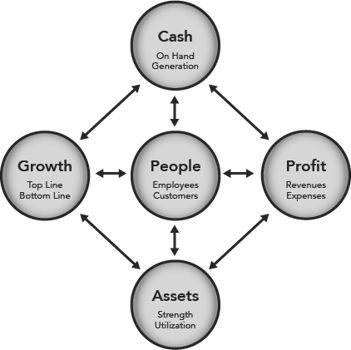
All of this, outward-facing and inward-facing, sits on top of one underlying model: the 5 Business Drivers, cash, profit, assets, growth, and people. It's a principle-based way of understanding what any business, a customer's or your own, is trying to accomplish and where its real challenges are. It draws on real financial and business substance, enough that CPAs can earn CPE credit for the training, but it's built to be usable on a sales call, not just in a classroom, so a rep doesn't need an accounting background to apply it well. It's the exact same framework whether a rep is running Challenger, Sandler, SPIN, MEDDIC, Solution Selling, Consultative Selling, Integrity Selling, or a homegrown process tracked through Salesforce, HubSpot, or Pipedrive, because it was never built around a methodology or a platform. It was built around how businesses actually work, which doesn't change based on what a sales team happens to call its process.
So whatever your team runs today, there are two ways to build that fluency.
Acumen Intelligence™
For reps who need that homework done fast, Acumen Intelligence builds an account-specific briefing before the call, doing in minutes what would otherwise take hours of research, so the insight walking into the room is grounded in that company's actual situation.
Full Account Analysis
Enter a public company and get executive priorities, financial signals, and strategic focus areas—mapped to the 5 Business Drivers.
Read or Listen to the Call
Go straight to the source with thousands of earnings call transcripts and recordings—read the moment or hear it in the executive's own words.
AI Sales Co-Pilot
Chat with a co-pilot trained on our methodology to shape talking points, pressure-test your case, and walk into the next call ready.
Corporate Sales Training
Get your team trained. Acumen Learning's corporate training programs teach the 5 Business Drivers directly and give reps live practice applying them, building the fluency to do that homework well on any account, without starting from zero every time.
Tool-Agnostic Prompting
Reps learn prompts that work with Claude, ChatGPT, Copilot, Gemini, or whatever's in your tech stack—these skill travels with the rep.
Grounded in the 5 Business Drivers
Every search maps to Cash, Profit, Assets, Growth, and People—so the output speaks the language the C-suite actually measures.
From Research to Talk Track
Reps turn financial findings into an executive-ready business case and talking points—not just a pile of data they don't know how to use.
The Book Behind the Framework
One book, endorsed across every major methodology.
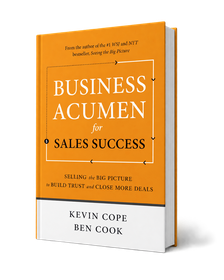
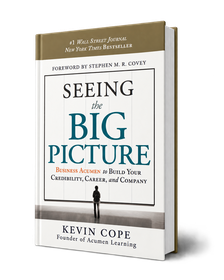
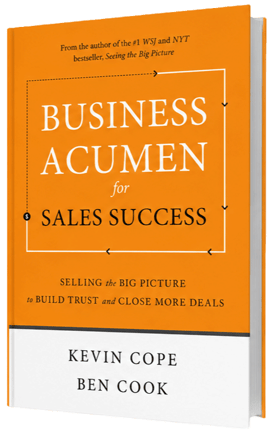
If seven different sales methodologies all run into the same ceiling, the fix is worth reading about directly. Business Acumen for Sales Success is where the 5 Business Drivers framework comes from, the same framework taught inside 34 Fortune 50 companies. It's earned endorsements from sales leaders across the industry, including Matt Dixon, who co-authored The Challenger Sale itself, and Anthony Iannarino, Stephen M.R. Covey, Jill Konrath, and Jeb Blount. Whatever methodology or process your team runs today, this is the book that makes it sharper.
Trust is built when salespeople align what they offer with the real business challenges of their clients. In a world flooded with superficial pitches, Business Acumen for Sales Success fills a glaring gap by arming sellers with the clarity, discipline, and insight to speak in the language executives respect. This is more than a sales book, it's a bridge to credibility, value, and enduring trust.
— Stephen M.R. Covey
Bestselling author of The Speed of Trust and Trust & Inspire
Want a copy?

Frequently Asked Questions About Business Acumen and Your Sales Process
Do we need to be running a named methodology like Challenger or MEDDIC for this to work?
No. Business acumen strengthens any sales process, a named methodology, a homegrown process built internally, or opportunities simply moving through Salesforce, HubSpot, or Pipedrive stages. The 5 Business Drivers framework applies to how reps understand the business they're selling into, independent of what the surrounding sales process is called.
We just move deals through Salesforce or HubSpot stages without a formal methodology. Does this still apply to us?
Yes. That's a homegrown methodology, and it's exactly what most sales organizations actually run, even ones that don't call it anything specific. Business acumen gives reps a way to understand the account behind the opportunity, so whatever stages that deal moves through are backed by real strategic understanding rather than a status update.
What's the fastest way to get my team doing this well, regardless of methodology?
Three starting points, depending on how deep you want to go: read Business Acumen for Sales Success to learn the 5 Business Drivers framework, enroll your team in Acumen Learning's corporate training for hands-on fluency, or use Acumen Intelligence to generate account-specific briefings before every call.
Can new or junior reps use this, or is it built for experienced sellers?
Both, though it changes what it does for each. Experienced reps use it to sharpen instincts they've already built. Newer reps use it to skip years of trial and error, since business acumen gives them a way to understand an account's real pressures from early in their ramp instead of learning it deal by deal.
How is this different from general sales training?
Most sales training teaches reps how to run a conversation, when to ask what, how to handle objections, how to close. Business acumen teaches reps what's actually true about the business they're talking to, so whatever conversation structure they're running is grounded in something real instead of a script.
What if different reps on our team run different methodologies?
That's fine, and actually common. Business acumen doesn't require standardizing on one named methodology across a team. It's the same underlying fluency whether a given rep runs Challenger, Sandler, a homegrown process, or something else entirely, so a mixed team benefits without anyone needing to change how they sell.